When Should You Call an Emergency Electrician? Here’s the Line
Call an emergency electrician any time you notice heat, smoke, sparks, a burning smell, or a hot electrical panel. Those symptoms mean something is failing right now, and waiting overnight is a gamble you should not take.
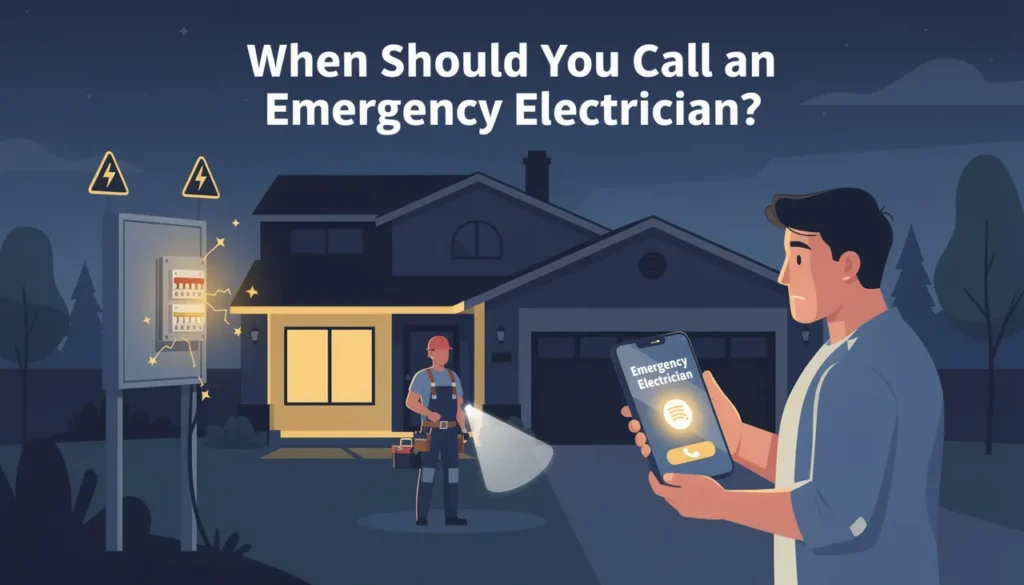
When to Call an Emergency Electrician: The Short Answer
Deciding when to call an emergency electrician comes down to one question: is something producing heat, smoke, or sparks that should not be? If yes, that is an emergency. Everything else can usually wait for a scheduled visit, and knowing the difference saves you both risk and money.
The reason is simple. Electrical faults that generate heat are actively getting worse while you wait. A loose connection arcing inside a wall does not pause overnight because you went to bed. Faults that just interrupt power, like a dead outlet or a tripped breaker that resets and holds, are annoying but stable.
Here is the quick sorting table we use when people call our emergency electrician line in Whitby:
| What you noticed | Call now or book a visit? | Why |
|---|---|---|
| Burning or fishy smell with no obvious source | Call now | Overheating insulation gives off this odour before visible smoke |
| Panel, outlet, or switch is warm or hot to touch | Call now | Heat at a device means a failing connection or overloaded conductor |
| Buzzing, crackling, or popping from the panel | Call now | Audible arcing, one of the last warnings before component failure |
| Sparks from an outlet when nothing was plugged in | Call now | Uncontrolled arcing, not the tiny static snap of plugging in a cord |
| Breaker trips again immediately every time you reset it | Call now | The breaker is detecting a live fault, not an overload |
| Scorch marks or melted plastic on an outlet or cord | Call now | Evidence a fault already produced serious heat |
| Water leaked onto the panel or an outlet | Call now | Water and energized equipment need professional isolation |
| One dead outlet, no heat or smell | Book a visit | Stable fault, likely a tripped GFCI or a failed device |
| Breaker tripped once, reset, and holds | Book a visit | Probably a temporary overload, worth diagnosing but not urgent |
| Lights flicker briefly when the furnace or AC starts | Book a visit | Common voltage dip, worth checking if it worsens |
The Seven Signs We Treat as Emergencies
A burning smell tops the list. Overheating wire insulation produces a distinct odour, often described as fishy or like burning plastic, and it frequently shows up before any visible smoke. If the smell is strongest near the panel or a specific outlet, that is your fault location.
Heat comes next. Press the back of your hand near (not on) your breaker panel. A healthy panel runs at room temperature. Warmth you can feel from a few centimetres away, on the panel or on any outlet or switch plate, means current is flowing through a connection that is breaking down.
Sound is the third giveaway. Panels should be silent. Buzzing, crackling, or popping is the sound of electricity jumping a gap, and arcing chews through metal contacts fast.
The remaining four: sparks from outlets, a breaker that re-trips instantly on reset, visible scorching or melted plastic, and water contacting live equipment. Any one of these justifies an after-hours call. Two together justify hanging up with us and considering 911 if smoke appears.
What Should You Do While You Wait?
Knowing when to call an emergency electrician is half the job. The other half is what you do in the twenty minutes before help arrives, and a few simple moves make a real difference.
Shut off the main breaker if you can do it safely. It is the large double breaker at the top of your panel. Killing the main stops current flow through whatever is failing, and no, you will not damage anything by shutting it off under load. Your fridge and freezer will ride out a short outage without complaint, so do not let food anxiety talk you out of it.
Do not open the panel cover, even with the main off. The supply conductors feeding the main breaker stay energized, and they carry enough current to be lethal. Panel interiors are our job, and Ontario law backs that up: homeowners can do limited electrical work in their own home, but live diagnosis is not the place to try.
Unplug what you can reach safely, especially anything on the circuit that was acting up. If the burning smell strengthens, or you see smoke or flame, get everyone out and call 911 from outside. Fire moves through wall cavities faster than most people expect.
Feels Urgent, Usually Is Not
Plenty of late-night calls we get are genuinely stressful but not dangerous, and being honest about that matters more to us than billing an after-hours premium. A dead outlet with no heat or smell is the classic example. Nine times out of ten it is a tripped GFCI upstream, sometimes in a different room entirely, or a device that simply wore out.
A single breaker trip that resets cleanly falls in the same bucket. Breakers exist to trip. One trip while the kettle, toaster, and microwave all ran together is the system working as designed. The pattern to watch is repetition: the same breaker tripping weekly is telling you something, and that deserves a proper electrical troubleshooting visit rather than a panicked midnight call.
Rising electricity bills, a switch that stops controlling a light, or an outlet that grips plugs loosely are all book-a-visit items too. Real problems, stable timelines.
There is also a middle category worth naming: situations that start stable and then change. A breaker that used to trip monthly and now trips daily, or a flicker that spread from one room to three, is a fault progressing. You do not need the emergency line at midnight for those, but you also should not sit on them for another season. Book the visit this week.
Why Older Whitby and Durham Homes See More of This
Electrical distribution equipment, meaning panels, wiring, cords, and connections, remains one of the leading ignition sources in Ontario home fires. The Electrical Safety Authority’s Ontario Electrical Safety Report has tracked in the range of 430 to 450 such fires per year across the province in recent reporting, and while that number dropped 18 percent between 2019 and 2023, aging equipment is consistently flagged as a contributing factor.
Durham Region’s housing stock explains why we see our share. Neighbourhoods in downtown Whitby, Oshawa, and Port Perry include plenty of homes wired 50 to 80 years ago, when a house was expected to run a fraction of today’s load. Original panels from that era, and in some cases original wiring that is due for replacement, are doing work they were never sized for.
That does not mean an older home is a fire waiting to happen. It means the warning signs above deserve faster respect in a 1960s bungalow than in a 2015 build, because the margins are thinner.
Put the Number in Your Phone Tonight
Do one practical thing before this page slips your mind. Walk to your panel, put your hand near it to confirm it is cool and silent, and note any breaker that feels warm. Then save an emergency electrician’s number in your phone, whether it is ours or someone else’s, because searching for one at 2 a.m. with a burning smell in the hallway is the worst time to start comparing options.
If you want that checked professionally, our emergency electrical service covers Whitby and all of Durham Region, and the same licensed master electrician who answers the emergency line handles scheduled safety checks too.
Frequently Asked Questions
Is a dead outlet an electrical emergency?
Usually not. A single dead outlet with no heat, smell, or scorch marks can wait for a normal service call. It becomes urgent if the outlet is warm, discoloured, or smells burnt, because those point to a failing connection behind the wall.
Should I call 911 or an electrician first?
If you see smoke or flames, or the burning smell is strong and getting worse, call 911 first and leave the house. An electrician handles the repair after the fire department confirms the home is safe. For warning signs without smoke or fire, call the electrician directly.
Does emergency electrical service cost more than a regular visit?
After-hours calls generally carry a premium over a scheduled daytime visit, which is standard across the trade. We still quote a flat price before starting, so you know the cost up front rather than watching a clock.