What to Do When Your Power Goes Out: A Whitby Checklist
When the power goes out, first determine whether the outage is the grid's or yours: check your breakers and glance at the neighbours. Then unplug sensitive electronics, keep the fridge closed (food stays safe about 4 hours, a full freezer about 48), and report the outage to your utility.
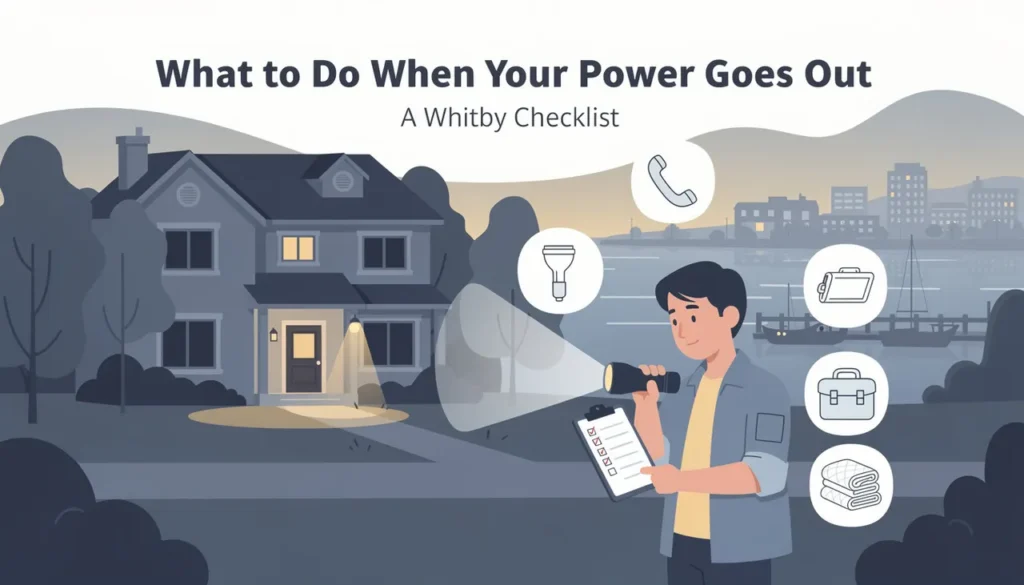
First, Figure Out Whose Outage It Is
Knowing what to do in a power outage starts with one diagnostic question: is this the grid or is this your house? The answer changes everything that follows, and it takes under a minute to get.
Look outside first, before touching anything. Streetlights dark and neighbours’ windows black means a utility outage; report it, note the time, and settle in. Neighbours glowing while your house sits dark means the problem is on your side of the meter, and no utility crew is coming to fix it. Check your panel next: a main breaker in the tripped position, or one branch breaker off while the rest of the house runs, tells you the story is local.
| What you see | What it means | Your move |
|---|---|---|
| Whole street dark | Grid outage | Report to your utility, protect food and electronics |
| Your house only, main breaker tripped | Your service or a major fault | Reset once; if it re-trips, call an electrician |
| Part of your house dead | Tripped breaker or failed connection | Check the panel, then GFCIs; persistent means diagnosis |
| Lights browned-out or half-bright | Possible lost utility neutral | Shut off sensitive loads, call the utility and an electrician |
| Power flickering on and off | Grid instability or a failing connection | Unplug electronics, observe whether neighbours match |
That half-bright row deserves emphasis: dim or weirdly uneven lighting across the house can mean a lost neutral, a condition that can cook electronics and deserves same-day professional attention, not patience.
What to Do in a Power Outage: The First Ten Minutes
Once you know it is a genuine grid outage, work the short list. Unplug computers, televisions, and anything with a delicate electronic brain, because the risk window is restoration, when voltage can wobble as the grid comes back. Leave one lamp switched on as your beacon so you notice the moment power returns.
Keep the refrigerator and freezer doors closed, tape a note to the handle if the household needs reminding, and start a rough mental clock: about 4 hours of safety in the fridge, about 48 in a full freezer, 24 in a half-full one. Report the outage to your utility rather than assuming someone else has; their outage map also gives you a restoration window that makes every other decision easier.
Then check on the humans: anyone on powered medical equipment gets priority, and their backup plan should already exist. Flashlights beat candles on every safety measure ever compiled, and if the outage is a winter one, close doors to unused rooms now to bank the heat while you have it. A text to a neighbour costs nothing and catches the situations nobody plans for, the senior alone next door being the classic one.
Running a Generator Without Making the News
Portable generators keep the essentials alive, and they also kill people every year, almost always the same way: carbon monoxide from a unit running in a garage, a covered porch, or too close to the house. The rules are not negotiable. Outdoors only, at least 20 feet from any window, door, or vent, exhaust aimed away from the building, rain cover if needed, and never, in any circumstance, in the garage with the door open as a compromise.
The electrical side has its own law worth respecting: never backfeed your house by plugging a generator into a wall outlet. It energizes dead lines, endangers the crews restoring your power, and it is illegal for good reason. Extension cords direct to appliances are the safe amateur method; the proper household method is a transfer switch or interlock, installed by a licensed electrician so the connection is safe by design rather than by luck.
If outages are becoming a pattern in your part of Durham, that installed-transfer-switch conversation is worth having on a calm sunny day instead of during the third dark evening of an ice storm.
When the Outage Stretches Into Hours and Days
Short outages are inconvenience; long winter ones become management problems, and knowing what to do in a power outage that outlasts the evening is mostly about heat and water. A house holds livable warmth for surprisingly long if you help it: close off unused rooms, keep exterior doors to a minimum, let sunlight in on south windows by day and cover glass at night. Layers and one designated warm room beat trying to defend the whole floor plan.
Pipes become the silent stake once indoor temperatures head toward freezing on multi-day outages. Opening cabinet doors under sinks on exterior walls and letting taps drip buys margin; a house that cannot stay above freezing needs its water shut off and lines drained, an hour of effort that guards against the most expensive outcome an outage can produce. Burst supply lines routinely cause more damage than the outage itself, and they do it silently, behind walls, while everyone is focused on the dark.
Know your leave threshold in advance too. Powered medical equipment without backup, infants in a cooling house, or temperatures you cannot hold are all fine reasons to decamp to family or a warming centre, and deciding that threshold calmly beforehand beats negotiating it by flashlight. Durham’s utilities publish restoration progress; believe the map more than optimism.
Never bring combustion indoors to chase warmth. Barbecues, camp stoves, and patio heaters produce the same carbon monoxide as a generator exhaust, and every extended outage adds tragedies from exactly this shortcut. If the outage outlasts your heat, leave; the house will forgive you.
When the Lights Come Back
Restoration has its own checklist, shorter than the outage’s but worth doing in the same deliberate order. Give the grid a few minutes to stabilize before plugging the sensitive electronics back in, then reintroduce them a few at a time rather than all at once. Reset clocks, check that the furnace or AC restarted properly, and confirm the fridge and freezer are cooling.
Then do the audit the outage made possible: check the freezer contents for ice crystals, the deciding line between refreeze and discard, and walk the house once looking for anything that did not come back. A dead circuit after an outage, a breaker that will not hold, or a burning smell anywhere gets treated as its own event, and a proper diagnosis beats hopeful resetting every time.
Build the Kit While the Lights Are On
Every checklist above runs smoother with ten minutes of preparation done in advance. The kit: flashlights where you can find them blind, batteries, a power bank for phones, a cooler and frozen gel packs, and your utility’s outage number saved in your phone. Households that lose power more than rarely should add the bigger conversation about standby power to the list.
Do the walk-through tonight: find your panel, identify the main breaker, and make sure the people you live with can do the same, including the teenagers. The difference between a stressful outage and a boring one is mostly decided before the lights ever flicker, in exactly these ten unhurried minutes.
Frequently Asked Questions
Should I unplug things during a power outage?
Yes, the sensitive ones. Computers, TVs, and appliances with electronic boards are vulnerable to the voltage fluctuations that can accompany restoration. Unplug them, leave one lamp on as your signal, and plug things back in gradually once power has been stable for a few minutes.
How long is food safe when the power is out?
With the doors kept closed, a refrigerator protects food for about 4 hours, a full freezer for roughly 48, and a half-full freezer for about 24. After that, move perishables to a cooler with ice, and refreeze only items that still hold ice crystals.
Who do I call about a power outage in Whitby?
Report grid outages to your utility, which for most of Whitby and Durham Region is Elexicon Energy; their outage map confirms whether crews already know. If your house is the only one dark, or only part of your house is dead, that is an electrician call instead.