Standby vs Portable Generator: Which Is Right for Your Home?
A standby generator delivers 10 to 26 kilowatts automatically within seconds of an outage and powers the whole house. A portable delivers 3 to 8.5 kilowatts of essentials with manual setup each time. The right choice depends on outage frequency, medical needs, and how hands-on you want to be in an ice storm.
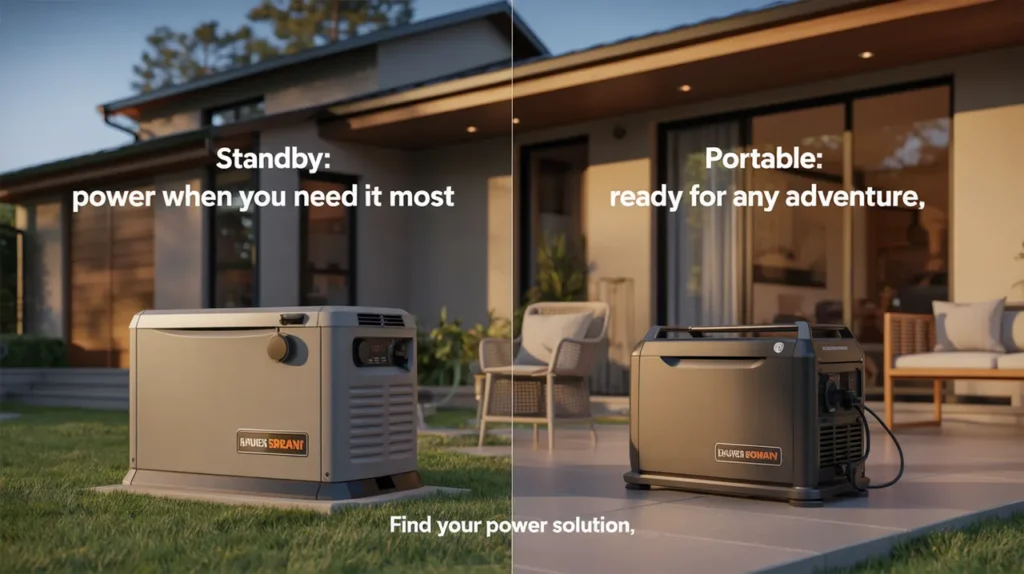
The Standby vs Portable Generator Question in One Table
Every standby vs portable generator decision trades the same four things: capacity, convenience, safety architecture, and money, and no marketing brochure escapes that arithmetic. The table first, then what the rows mean in a real Durham Region ice storm.
| Standby | Portable | |
|---|---|---|
| Typical output | 10 to 26 kW | 3 to 8.5 kW |
| What it powers | Whole home, HVAC included | Selected essentials |
| Starts | Automatically, seconds after outage | You, outside, pulling a cord |
| Fuel | Natural gas or propane, continuous | Gasoline you store and refill |
| Runtime | Days, as long as gas flows | 8 to 12 hours per tank |
| Connection | Automatic transfer switch, permanent | Manual transfer switch, interlock, or cords |
| Installed by | Licensed electrician plus gas fitter, permits | Cords: nobody. House connection: licensed electrician |
| Works while you are away | Yes | No |
The rows that decide most households are the two nobody prices: starts automatically, and works while you are away. A standby covers the outage that hits during your Florida week and the one that hits at 3 a.m. in freezing rain; a portable covers exactly the outages you are home, awake, and willing to work for.
What the Kilowatt Numbers Buy You
Capacity math turns abstract fast, so anchor it to the appliances you would actually miss. A 5 kW portable comfortably runs a refrigerator, sump pump, furnace fan, some lights, and phone charging, which is genuine resilience. What it cannot do is run central air conditioning, an electric range, and a dryer on top, because the arithmetic simply does not fit in 5,000 watts.
A 10 to 14 kW standby covers a typical gas-heated home’s full panel with modest management, meaning the transfer switch sheds a couple of luxury loads at peak, and the 18 to 26 kW tier exists for houses with electric heat, pools, or big cooling loads that refuse to negotiate. Sizing is a load calculation, the same discipline that governs panel and service work, and it is worth doing honestly because oversizing wastes thousands while undersizing discovers itself at the worst moment.
One planning note for electrified households: EV chargers and heat pumps change generator math the same way they change service math. If your five-year plan electrifies heating or driving, size the backup for that house, not this one.
The Safety Gap Is Wider Than the Price Gap
Here is the part of the comparison that deserves the boldest print. Portable generators are involved in roughly a hundred carbon monoxide deaths a year in North America, nearly all preventable, nearly all the same story: a unit running in a garage, basement, or too near a window. The rules that keep the story from being yours: outdoors only, 20 feet minimum from any opening, exhaust pointed away, and a working CO alarm inside regardless. Newer portables with CO shutoff sensors are worth their premium.
Standby units sit outside that risk category almost entirely: permanently installed away from openings, exhaust engineered like a furnace’s, fuel plumbed rather than poured. Their safety story is the professional installation itself.
The electrical connection carries the other safety line. Any path that feeds house wiring, for either generator type, runs through a transfer switch or interlock installed under an ESA permit, because the alternative people improvise, backfeeding through a wall outlet, energizes the very lines utility crews are working to restore. It risks lives beyond your property line, which is why it is illegal and why no legitimate electrician will wire around it.
The Money Conversation, Honestly
A capable portable costs hundreds to low thousands, plus a manual transfer switch installation if you want it feeding circuits properly. A standby is a project: the unit, the automatic transfer switch, a concrete pad, gas fitting, and electrical work, landing well into five figures all-in for most homes. That gap is real and it buys real things: automation, capacity, runtime, and the ability to protect an empty house.
The middle path more Durham homeowners should know about: a quality portable plus a professionally installed interlock and inlet. It delivers safe, code-compliant house feeding at a fraction of standby cost, keeps the manual routine, and leaves the standby upgrade path open. For households whose outages are occasional rather than chronic, it is frequently the rational answer, and we say so even though the full standby installation is the bigger ticket.
What Standby Installation Actually Involves
Since the installation is half of what you are buying, it deserves demystifying. A standby project runs: load calculation and siting first, respecting clearances from windows, doors, gas meters, and property lines; then a pad or gravel base outside; gas fitting by a licensed gas technician for the natural gas or propane feed; and the electrical scope, mounting the automatic transfer switch beside your panel and integrating the circuits, under an ESA permit with inspection. Most residential installs occupy one to two site days after the planning is done, and the unit self-tests weekly afterward.
Maintenance is real but modest: an annual service, oil and filter on schedule, and battery replacement every few years, comparable to caring for a small engine that must never fail to start. Noise sits around normal-conversation level for modern units, a consideration for placement near bedrooms and lot lines, and municipal bylaws set the boundaries there.
The portable path has its own installation moment worth doing right: the interlock or manual transfer switch, the exterior inlet, and a labelled plan of which circuits live during an outage. An hour of electrician time turns the cord-spaghetti version of portable power into something a stressed household member can operate safely in the dark, which is the actual test that matters.
Match the Machine to Your Outage Life
Choose standby if any of these are true: someone depends on powered medical equipment, you travel and the house cannot tolerate dark days, your area loses power multiple times a year, or a sump pump stands between your basement and real damage. The automation is the product; everything else is specification.
Choose portable, ideally with an interlock, if outages are occasional, someone able-bodied is generally home, and the budget has better uses than protection against rare events. There is no wrong answer here, only mismatches between machine and household, and the mismatches run both directions: the standby that self-tests weekly for outages that never come, and the portable that stays buried behind the bikes during the storm it was bought for.
Whichever way you lean, buy the decision once. Households that split the difference with a bargain generator, no transfer equipment, and good intentions end up owning the risks of both paths and the benefits of neither.
The next step is the same for both paths: a load calculation and a site look. Bring us your panel photo and your outage stories, and the answer comes back sized, permitted, and priced flat, whichever side of the standby vs portable generator line your house actually belongs on.
Frequently Asked Questions
Do I need an electrician for a portable generator?
For extension-cord use, no. The moment you want the generator feeding house circuits, yes: a transfer switch or interlock must be installed under an ESA permit by a licensed electrician. Plugging a generator into a wall outlet to backfeed the house is dangerous and illegal.
How long can each type run continuously?
A standby unit on natural gas runs as long as the gas flows, effectively for days, with brief maintenance pauses on extended runs. Portables run until the fuel tank empties, typically 8 to 12 hours, and every refuel means going outside to a hot machine in whatever weather caused the outage.
Does a standby generator add resale value?
In areas with recurring outages it is an increasingly requested feature, and the permanent installation with permits transfers to the buyer in a way portable equipment never does. Treat it as a comfort purchase with a resale bonus rather than an investment that pays for itself.