Smart Home Wiring: What to Plan Before You Build or Reno
A smart home wiring plan is mostly boring electrical decisions made early: a neutral conductor in every switch box, deeper boxes for smart devices, spare panel capacity, and dedicated circuits where automation concentrates. Get those right before drywall and every future gadget has a home; miss them and each one becomes a renovation.
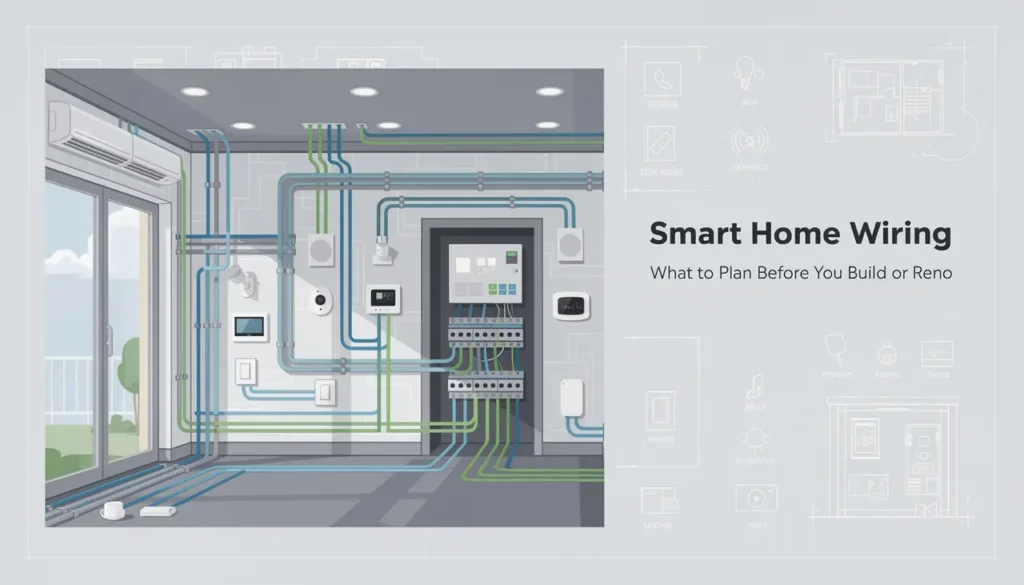
The Smart Home Wiring Plan Is Mostly About Copper, Not Gadgets
Strip the marketing off and a smart home wiring plan comes down to a data-driven observation: devices churn every few years, wiring lasts half a century, and the houses that automate gracefully are the ones whose copper anticipated the churn. The gadgets are replaceable by design. The decisions that persist live inside walls, and every one of them is cheapest at rough-in, exactly when nobody is thinking about them.
| Wiring decision | Why smart devices need it | Cost at rough-in vs after |
|---|---|---|
| Neutral in every switch box | Smart switches need power to think | Trivial vs opening walls |
| Deep boxes at switches | Smart devices are bulky behind the plate | Trivial vs box swaps later |
| Spare panel capacity | Automation adds circuits over time | Planning vs panel upgrade |
| Whole-home surge protection | A house of electronics to defend | Minutes at an open panel |
| Dedicated circuits at hubs | Concentrated always-on equipment | One cable run vs retrofit |
| Three-wire runs to fixtures | Options for fans, controls, zoning | Metres of wire vs regret |
The Neutral Wire: The Whole Plan in One Conductor
If this post taught only one thing, it should be the neutral. Traditional switch loops in older homes often carried just two conductors, enough to interrupt a circuit and nothing more, and every generation of smart switch since has needed a neutral in the box to power its own electronics continuously. The workarounds for neutral-less boxes, special switches, compatibility lists, occasional flicker, all exist because someone saved a few cents of wire decades ago.
The plan, therefore, is one sentence: a neutral conductor lands in every switch box in the house, no exceptions, including the three-ways and the closet nobody automates yet. In new construction and renovations this costs effectively nothing, and modern code practice already pushes this direction. In existing homes, it is the first thing an electrician checks when you ask whether your house can take smart switches, and the answer maps almost perfectly to the house’s era, the same era logic that runs through our rewiring guides.
Box depth is the neutral’s quiet partner. Smart switches and dimmers carry radios and power supplies behind the plate, and a crowded shallow box turns a five-minute device swap into a wrestling match. Specifying deep boxes at rough-in costs pennies per location and buys every future upgrade an easy home.
Circuits, Capacity, and the Panel That Feeds It All
Automation’s electrical appetite is individually tiny and collectively real. Each smart device sips standby power, hubs and controllers run continuously, and the pattern of a smart household, more devices, more chargers, eventually the EV and the heat pump, points one direction: load grows. The wiring plan meets that with spare breaker spaces in the panel, a dedicated circuit wherever equipment concentrates, and honest service capacity math done before the additions arrive rather than after.
Surge protection graduates from optional to sensible in this house. A single whole-home surge protective device at the panel stands guard over every board and radio in the building, and it is a minutes-long install when the panel is open for other work. Layer point-of-use protection at the most expensive electronics and the defence is complete for less than one dead hub costs to replace.
Two placement notes earn their keep for the equipment itself: give the spot where controllers and always-on gear will live its own receptacle on a dedicated circuit in a ventilated closet or utility space, and put exterior receptacles and soffit power where future outdoor devices, cameras excepted from our scope, holiday lighting included in it, will want them. Power in the right place is the whole game; what plugs in is next decade’s problem.
Planning the Loads That Think for Themselves
Beyond switches, the near-future smart home is really an energy-management home, and the wiring plan should see it coming. Smart thermostats want proper control wiring to the mechanicals. EV chargers arrive with scheduling brains and, increasingly, load-management features that interact with the panel, the full story of which lives in our EV charging guides. Heat pump controls, automated blinds on line voltage, motorized garage and gate equipment: each is an ordinary circuit at rough-in and an expensive afterthought later.
The honest scope note from a licensed electrician: the low-voltage world of data cabling and security systems is its own trade, and this plan deliberately stays on the line-voltage side, where the ESA permit, the licensed work, and the decades-long copper decisions live. Run the electrical plan first and generously; the low-voltage layer threads through afterward far more easily than the reverse.
What ties it together is documentation, the least glamorous smart feature of all: a labelled panel, a circuit map, and notes on which boxes carry neutrals and depth. The next electrician, the next owner, and the next gadget all read that map, and houses that have one upgrade for the cost of parts.
Retrofitting the House You Already Own
No open walls? The same smart home wiring plan still applies, just resequenced around access. The first step is an audit rather than a rough-in: an electrician checks a sample of switch boxes for neutrals and depth, counts the panel’s spare spaces, and maps which rooms are automation-ready today versus which need wiring work first. In post-1990 Durham homes the audit usually brings good news, since neutrals at switches became standard practice; older eras get the honest map of where the gaps are.
Retrofit priorities then follow value: surge protection at the panel first, since it protects everything and needs no wall opened; smart switches in the rooms whose boxes already qualify second; and the neutral-and-box upgrades for the remaining rooms bundled with whatever renovation or rewiring work touches those walls anyway. Piggybacking is the entire cost strategy, because a box upgraded during a painting-and-patching season costs a fraction of the same box as a standalone mission.
What retrofits should skip is heroics: fishing new switch loops through insulated exterior walls to automate one seldom-used light is money that serves the house better almost anywhere else. Automate what is ready, schedule what is not, and let the plan absorb the house at renovation speed.
The One-Page Plan to Write Before Any Wall Opens
Sit down with your floor plan and write the boring page: every switch location marked for neutral-and-deep-box, the equipment corner circled for its dedicated circuit, the panel’s spare capacity counted, surge protection noted, and the five-year loads, car, heat, hot tub, suite, listed with a checkmark for whether the service math covers them. That page is the entire smart home wiring plan, and it costs an evening.
Bring it to whoever wires your build or renovation, and if that is us, it comes back priced flat with the ESA permit included and the copper specified for the decades. The gadgets will come and go on their own schedule; your walls only open once, and the houses that remember that are the ones that stay effortlessly current.
Frequently Asked Questions
Smart switches or smart bulbs: which should the wiring plan assume?
Plan for smart switches. They control the fixture for everyone, work like normal switches for guests, and survive bulb replacements. Smart bulbs suit lamps and rentals. The wiring implication is concrete: switches need neutrals and box depth, which is exactly what the plan provides.
Do smart devices need special electrical panels?
No special panel, but they reward a healthy one: spare breaker spaces for added circuits, and modern protection devices. Whole-home surge protection at the panel is the one upgrade that directly serves a house full of electronics, and it installs best when the panel is already open.
Does a smart home wiring plan lock me into one brand?
Good wiring is brand-agnostic, which is the point. Neutrals, deep boxes, and sound circuits serve every ecosystem, and standards keep converging toward interoperability. Plan the copper for decades and let the gadgets be replaceable; the reverse strategy ages badly.