Signs of an Electrical Fire in Your Home: Catch It Early
The early signs of electrical fire include a persistent fishy or burning-plastic smell, warm or discoloured outlets and switch plates, repeated breaker trips on one circuit, and flickering tied to a specific wall. Electrical failures cause roughly one in five fires in Canada, and nearly all of them give warnings first.
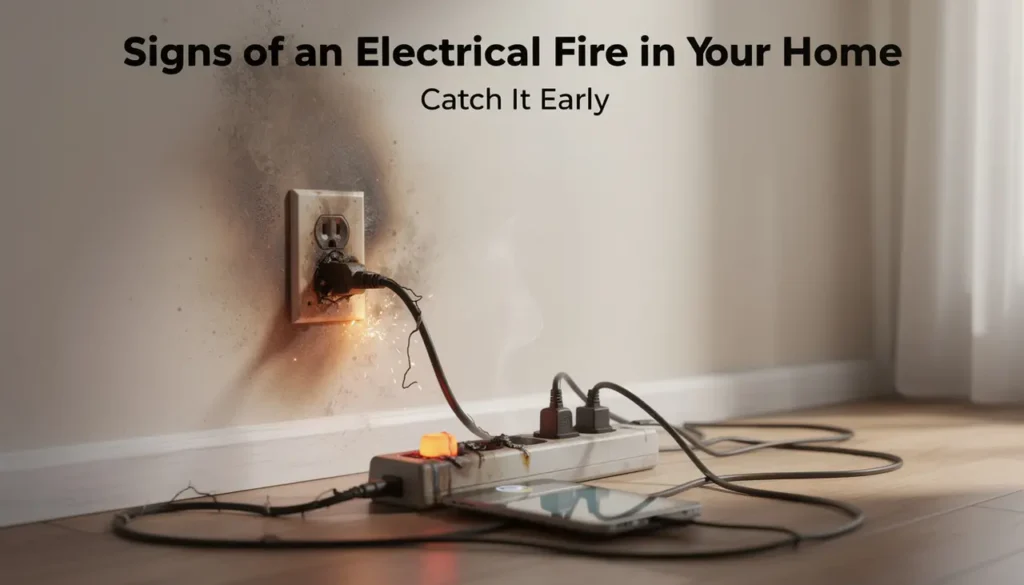
The Fires I Worry About Start Quietly
Seventeen years in this trade has taught me that the signs of electrical fire rarely involve visible flames until late in the story. The ones that scare me start as a faint fish smell nobody can place, a switch plate that runs a little warm, a breaker with a habit. Roughly one in five fires in Canada traces back to electrical causes, and in my experience the house almost always tried to say something first.
So this post is the list I wish every homeowner had taped inside a kitchen cupboard: the warning signs I take seriously in other people’s houses, ranked in the order I take them seriously, with what each one physically means and how fast to act on it.
Seven Signs of Electrical Fire Risk, Ranked by How Fast I Move
| Sign | What is actually happening | How fast to act |
|---|---|---|
| Fishy or burning-plastic smell, no source | Insulation overheating somewhere hidden | Same day |
| Warm or hot outlet, switch, or panel | A connection failing under load | Same day |
| Scorch marks or browning on a plate | Arcing already happened there | Same day |
| Buzzing or sizzling from a wall or panel | Active arcing | Immediately |
| One breaker tripping repeatedly | A circuit protecting itself from a fault | Within days |
| Flickering tied to one wall or room | A loose connection making and breaking | Within days |
| Lights dim when appliances start, worsening | Loaded or deteriorating service equipment | Book an assessment |
Any single row earns attention. Rows one through four appearing together is the point where I tell people to stop reading and start dialling, because that combination is what our emergency electrician calls exist for.
Why Your Nose Knows First
The fish smell deserves its own explanation because it fools everyone. Modern wiring insulation and device plastics release specific compounds when they overheat, and to the human nose the result reads as fish, sometimes as urine or hot plastic. It shows up well below the temperature where anything visibly burns, which makes it the earliest warning the house can give you.
The pattern that matters is persistence and location. A smell that reappears in the same room, strengthens when certain things run, and cannot be traced to a meal is electrical until proven otherwise. I have opened walls on the strength of that smell alone and found connections cooked black, centimetres from framing lumber that had not caught. Yet.
Heat You Can Feel Through Paint
Electricity moving through a sound connection produces almost no heat at the wall. Put your hand on any outlet plate in a healthy house and it feels like the wall around it. Warmth means resistance at a termination, and resistance climbs as the connection degrades, which means the outlet that is warm this month can be scorching by winter.
Browning, bubbling paint, or a plate that has visibly yellowed around the edges tells you the heating has been happening for a while. In older Durham homes I also treat this as a prompt to ask what the wiring behind the plate is, because aging circuits carrying modern loads are a recurring theme in homes that eventually need rewiring.
The Fire You Cannot See Yet
Wall cavities are where electrical fires do their worst work. An arcing connection inside a box, or a nail nicked cable from a renovation years ago, can smoulder against dust and wood framing with nothing showing in the room but that faint smell or a warm patch of drywall. By the time smoke appears at a ceiling edge, the fire has usually been feeding for a while.
Hidden burning is also why the early signs of electrical fire matter more than any alarm: the smell and the warm drywall are often the only evidence that reaches the room. This hidden phase is exactly what arc fault breakers were invented to interrupt, and it is why they became code for living areas in new Ontario construction. It is also why I am conservative about mystery symptoms: a homeowner cannot inspect the inside of a wall, but a licensed electrician with a thermal camera and a methodical troubleshooting process can, without demolition.
The Habits That Start These Fires
Wiring gets blamed for everything, but a good share of the electrical fires I hear about through the trade started at the end of a cord. Space heaters lead the pack every winter: 1,500 watts through a dollar-store power bar, or through an extension cord pinched under a couch leg, is a fire recipe with a proven track record. Heaters plug into the wall, alone on the outlet, or they do not run. That rule alone would prevent a remarkable number of January tragedies.
Overloaded power bars generally come next, especially behind entertainment units and in home offices where one outlet feeds a small data centre. A quality bar with surge protection handles electronics fine; what it should never feed is anything that makes heat, meaning heaters, kettles, toasters, or irons. Daisy-chaining bars into bars multiplies the risk and violates the listing on every one of them.
Then there is the amateur wiring I find behind walls during renovations: junctions buried without boxes, connections taped instead of terminated, circuits extended with whatever wire was in the garage. Every one of those is a future warm spot waiting for the right load. If your house has changed hands a few times, and most Durham houses have, you inherit every shortcut previous owners took, which is a strong argument for having unexplained symptoms investigated rather than rationalized.
What to Do at Each Level of Worry
Active signs, meaning sizzling sounds, smoke, spreading burning smell: get people out, call 911, and shut off the main breaker on your way only if it is safely reachable. Nothing in the panel is worth breathing smoke for. The fire department would far rather attend a false alarm than a basement that waited.
Same-day signs, meaning smells, heat, or scorch marks without smoke: stop using the affected circuit, unplug what you can, and get a professional in. Habits and patterns, meaning the tripping breaker or localized flicker: book the diagnosis this week and write down what you observed, because the pattern is diagnostic gold for whoever investigates.
Tonight, before this post evaporates from memory, do the two-minute patrol: sniff test near the panel, hand near each outlet plate that carries big loads, kitchen, laundry, and any room on your worry list. Test the smoke detectors while you are at it, since the button takes five seconds per floor and the batteries are always older than anyone remembers.
Make the patrol seasonal and it becomes real protection: once when the heaters come out in fall, once when the air conditioning starts in spring. It costs nothing, takes less time than making coffee, and it is exactly how the quiet fires get caught early, while they are still just a smell and a warm spot instead of a headline.
Frequently Asked Questions
What does an electrical fire smell like?
Usually fish or burning plastic rather than smoke. Overheating wire insulation releases compounds with a distinctly fishy odour before anything chars, so a fish smell with no fish in the house is an electrical warning until proven otherwise.
Can an electrical fire start inside a wall without me knowing?
Yes, and that is what makes them dangerous. Arcing at a buried connection can smoulder in the wall cavity, showing nothing but a faint smell or a warm patch of drywall until it breaks through. Persistent localized smells or warmth deserve investigation, not air freshener.
Will a regular smoke detector catch an electrical fire?
Once there is smoke in the room, yes, which is why working detectors on every level are non-negotiable. But detectors respond to smoke, not to the overheating that comes first. The warning signs in this post exist so you can act before the detector ever has a job to do.