Outdoor Lighting Ideas That Add Value to Your Home
The outdoor lighting that adds home value is the layered, permanent, professionally wired kind: a properly lit entry, safe paths and steps, restrained landscape accents, and security coverage without glare. Buyer surveys consistently rank exterior lighting among the most desired features, and evening curb appeal is the cheapest staging a house can buy.
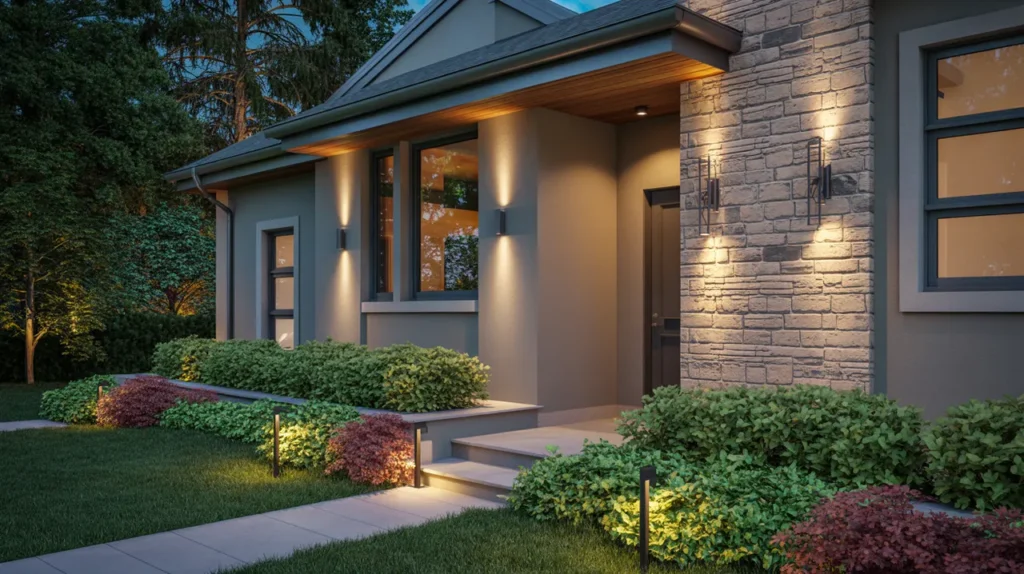
What Buyers Actually See After Sunset
Here is a pattern from years of working on houses that are about to be sold: the listing photos get shot at dusk, with every exterior light burning, because agents know that outdoor lighting ideas earn home value only after dark. Evening curb appeal genuinely sells houses. Surveys of homebuyers consistently rank outdoor lighting among the most desired exterior features, roughly four in ten calling it essential or desirable in recent industry polling, and a well-lit house at a 7 p.m. winter viewing simply outshows the dark one next door.
So the honest frame for outdoor lighting ideas is home value through a buyer’s eyes: what reads as permanent, maintained, and safe earns credit, while what reads as stapled-on decor earns nothing. That single frame sorts every idea in the sections below.
The Four Layers That Earn Their Keep
| Layer | What it includes | Why it carries value |
|---|---|---|
| Entry and facade | Sconces, over-door fixtures, house-number light | First impression, photographed in every listing |
| Path and steps | Walkway markers, recessed step lights | Safety a buyer’s family feels immediately |
| Landscape accents | Uplights on trees, garden washes | Depth and polish, the professional look |
| Security coverage | Motion fixtures at approaches, garage, side yard | Peace bought with photons, not promises |
The entry layer works hardest per dollar, and it is where I send every budget first. Matched sconces at proper scale, warm colour temperature, and a fixture over the door that actually illuminates faces does more for a facade than most paint jobs cost ten times as much to deliver, and it is the layer every visitor, every delivery, and every listing photo interacts with nightly.
Path and step lighting is the safety layer, and calling it decorative undersells it badly: dark steps are a genuine trip hazard for guests, deliveries, and aging knees alike, lit ones are a nightly courtesy, and buyers walking an evening showing register the difference without ever naming it. Landscape accents are where restraint pays its dividend; two or three uplit trees read as considered design, while a runway of fixtures along every garden edge reads as effort, and the difference in fixture count is the difference in taste. Security lighting completes the set, and research on the deterrent effect is consistent enough to state plainly: poorly lit homes make easier targets, and well-placed motion lighting at approaches removes the darkness a prowler prefers.
Permanence Is the Value Ingredient
The difference between lighting that impresses and lighting that appraises is mostly wiring. Hardwired exterior fixtures on dedicated, GFCI-protected circuits, switched and timed from inside, installed under an ESA permit, are improvements to the house; they transfer with the deed, pass inspections, and justify their line in a listing. Solar stakes and plug-in strings are pleasant, and they are furniture.
Getting the permanent layer right involves the unglamorous details Canadian weather audits annually: exterior-rated boxes and fixtures, weatherproof in-use covers on receptacles, connections that survive freeze-thaw, and the GFCI protection the code requires outdoors, covered in depth in our GFCI location guide. Control is the finishing touch that gets used daily: dusk-to-dawn photocells for the entry layer, timers or smart switches for the landscape layer, and motion for security, so the system runs itself and the hydro bill stays polite. LED fixtures make the operating cost a rounding error.
This is also the layer where doing it once matters, because exterior wiring poorly done becomes a troubleshooting call with a shovel involved. Trenched cable at proper depth, conduit where it belongs, and connections in accessible boxes are the difference between a system that lasts decades and a mystery that trips every April thaw.
Outdoor Lighting Ideas, Ranked by Home Value per Dollar
If the budget forces choosing, my order after years of exterior work: first, fix the entry, matched fixtures, warm light, faces visible at the door. Second, light every step and grade change on the property, because safety converts directly to daily quality of life. Third, add motion coverage at the driveway and side approaches, the security layer that works whether anyone admires it or not.
Fourth, accent two or three landscape features you actually love, not every shrub you own. Fifth, if entertaining space exists, give the patio or deck its own warm, dimmable zone, which extends the usable evening for months on either side of summer and shows beautifully. Beyond that, additions chase diminishing returns, and money left in the budget does more value work indoors on the pot light and interior lighting projects buyers also walk through.
What to skip entirely, from someone who removes as much lighting as he installs: colour-changing spectacle on a family home’s facade, fixtures that glare into neighbours’ windows and start feuds, and anything sold on raw brightness rather than placement. Lumens are not the metric; where they land is, and always was.
Designing for the Winter the Brochures Ignore
Every exterior lighting photo you have ever admired was taken in September, and every system I service earns its reputation in January. Canadian winter is the design constraint that separates lighting that lasts from lighting that disappoints, and it deserves its own checklist before anything gets bought.
Snow is the first editor: path fixtures that stand eight inches tall vanish under the first real storm, which argues for downlighting paths from posts and walls, recessed step lights set into risers, and any ground-level fixture placed clear of where shovels and snowblowers work. Ice is the second: fixtures and connections rated for wet locations handle freeze-thaw cycling; bargain hardware cracks its seals by the second winter and floods its sockets by the third. Salt spray near driveways and walks corrodes bargain finishes fast, so coated or composite fixtures earn their premium precisely where the shaker passes each storm.
Winter is also when the system pays its rent. Dark at five o’clock means the entry, path, and security layers work five months of long shifts, and it is when dusk-to-dawn automation stops being a convenience and becomes how the house welcomes everyone home. Plan for the season the brochures skip and the September photos take care of themselves.
Walk It Tonight, Wire It Once
The design process costs one evening and no tools beyond a notepad. Walk your property at dusk exactly the way a first-time visitor would: pause at the curb, come up the path, stand at the door, then continue around to wherever guests and family actually move after dark. Note every dark step underfoot, every unlit face-height moment at the door, every black corner a motion light would civilize, and the one or two trees genuinely worth celebrating after dark. Photograph the panel and the existing exterior outlets while you are out there.
That walk, written down, is the brief. Bring it to us and it returns as a layered plan on one flat quote, exterior circuits, GFCI protection, controls, and fixtures rated for the climate, installed under permit and built to be the same asset at resale that it is on tonight’s dark steps.
Frequently Asked Questions
Does outdoor lighting really increase resale value?
Surveys of buyers consistently place exterior lighting high on desired-feature lists, and a house that shows well at evening viewings carries an edge no spreadsheet captures. Treat precise return percentages skeptically; treat the buyer psychology seriously.
Low-voltage kits or hardwired fixtures: which adds more value?
Quality shows either way, but permanence is what buyers and inspectors credit. Hardwired fixtures on proper exterior circuits, installed under an ESA permit, read as part of the house; plug-in kits read as decor that may leave with the seller. Many strong designs mix both, anchored by the hardwired layer.
What colour temperature should outdoor lighting be?
Warm, generally 2700 to 3000K, for anything near the house and entertaining areas; it flatters brick, siding, and skin. Reserve cooler light for utility zones like driveways and side yards if used at all, and keep one temperature per visual zone to avoid the patchwork look.