Level 1 vs Level 2 EV Charging: What Whitby Drivers Should Know
Level 1 charging uses a regular 120-volt outlet and adds roughly 6 to 8 kilometres of range per hour. Level 2 runs on a dedicated 240-volt circuit and adds 40 to 60 kilometres per hour, which is why most daily drivers end up installing one.
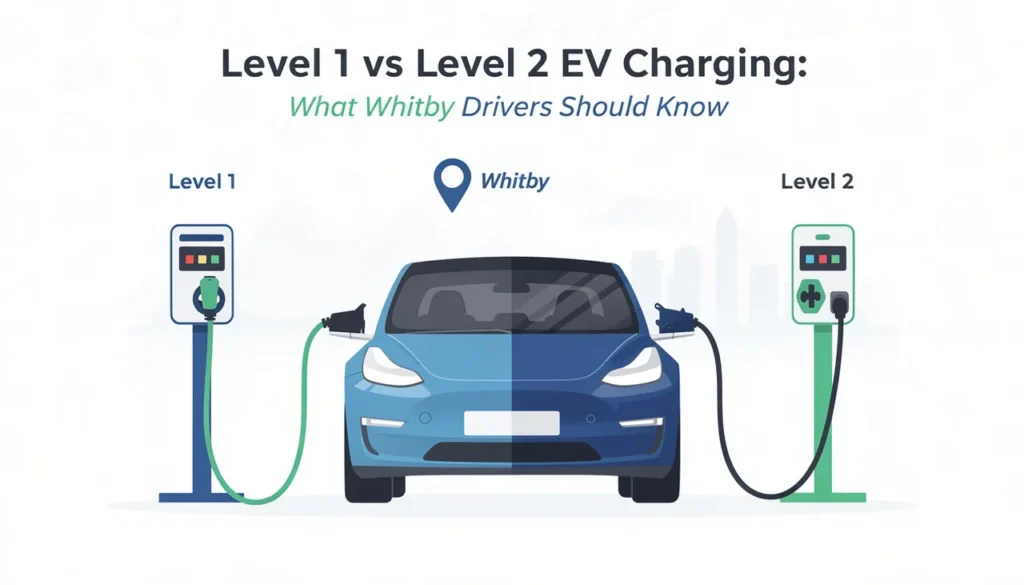
Level 1 vs Level 2 EV Charging: The Verdict Up Front
The level 1 vs level 2 EV charging question has a short answer: Level 1 is a backup plan, Level 2 is a daily driver’s tool. Level 1 uses the cord that came with your car in a standard wall outlet and restores roughly 6 to 8 kilometres of range per hour. Level 2 uses a dedicated 240-volt circuit and restores 40 to 60 kilometres per hour, sometimes more.
Whether the slow option is enough depends on one number: how far you drive on a typical day. Here is the comparison in full, then the math for deciding.
| Level 1 | Level 2 | |
|---|---|---|
| Voltage | 120 V, standard outlet | 240 V, dedicated circuit |
| Typical power | About 1.4 kW | 7 to 11.5 kW |
| Range added per hour | Roughly 6 to 8 km | Roughly 40 to 60 km |
| Overnight (10 hours) | 60 to 80 km | Full battery for most EVs |
| Hardware needed | Cord included with the car | Wall-mounted charger |
| Electrical work | None, usually | New circuit, ESA permit |
| Best for | Low-km drivers, second cars | Daily commuting, winter, one-car households |
How Each Level Actually Works
Both levels feed your car alternating current, and the car’s onboard charger converts it to direct current for the battery. The difference is simply how much power the wall can deliver. A regular outlet on a 15-amp circuit tops out around 1.4 kilowatts once you respect continuous-load limits. A Level 2 circuit at 32 amps delivers about 7.7 kilowatts, and a 48-amp setup pushes past 11.
That five-to-eightfold power gap is the entire story. There is no cleverness in a Level 2 charger that makes electrons better; it is a bigger pipe, professionally installed, wired as a dedicated circuit from your panel.
Circuit sizing follows from the charger’s draw, with continuous loads capped at 80 percent of breaker rating: a 32-amp charger sits on a 40-amp breaker, a 48-amp unit on a 60. This is why “just use an outlet I already have” rarely survives contact with the electrical code. Charging is the longest continuous load in a modern house, and the wiring serving it gets sized with that duty in mind.
Public fast chargers, the so-called Level 3 tier, are a different tool for a different job: road trips and top-ups, priced accordingly. Home is where the overwhelming share of Canadian EV charging happens, which is why the home circuit decision matters more than any app full of charging stations.
Do the Commuter Math Before You Decide
Take your honest daily kilometres and divide by 7. That is roughly how many hours of Level 1 charging you need every day to break even. A 40-kilometre round trip to work needs about 6 hours plugged in, which a normal evening at home covers easily. A 120-kilometre day needs 17 hours, which does not exist between dinner and breakfast.
Now layer in an Ontario winter. Cold batteries accept charge more slowly, and the car spends part of the incoming power warming the pack and, if you use preconditioning, the cabin. Real-world Level 1 gains in January can drop by a third or more. Drivers who were breaking even in September start falling behind in the new year, which is exactly when our install calendar fills up.
The one-question test: has your car ever been below the charge you needed in the morning? If yes, you have already outgrown Level 1.
What a Level 2 Install Involves Behind the Wall
The charger itself mounts near your parking spot, but the real work happens at the panel. A licensed electrician confirms your service and panel can carry the new load, runs a dedicated 240-volt circuit, and files the ESA permit that covers the work. In most Whitby homes with 200-amp service, that is a clean half-day job.
Homes on 100-amp service need an honest conversation first. Sometimes the load calculation still works. Sometimes a load-management device that pauses charging while the stove or dryer runs solves it. And sometimes the charger becomes the reason to do the service upgrade the house needed anyway. A proper assessment sorts this out before anyone drills a hole, and it is exactly the kind of question our electrical troubleshooting and assessment visits answer.
One buying tip while you compare hardware: check the nameplate amperage, not the marketing headline. A charger capable of 48 amps only delivers that on a 60-amp circuit, and there is no benefit paying for capacity your car’s onboard charger cannot accept.
The Overnight Rate Angle Ontario Drivers Should Not Miss
Speed is the headline in every level 1 vs level 2 EV charging comparison, but in Ontario the clock matters as much as the kilowatts. The province’s ultra-low overnight electricity price plan offers its deepest discount during the overnight window, with the trade-off of a premium during weekday evening peaks. It exists almost tailor-made for EV owners.
Level 2 is what lets you exploit it. A charger that fills the battery in four hours fits entirely inside the discount window, every night, automatically, using the scheduling built into the car or the charger. Level 1 cannot make the same promise for a longer commute, because a 14-hour charge inevitably spills into pricier hours on both sides.
Plug type is the other detail worth settling before purchase. Most non-Tesla EVs in Canada use the J1772 connector for Level 2 charging, Tesla uses its own plug, and adapters bridge the two in either direction. The wiring behind the wall is identical, so choose hardware for the car you have and the car you think is next, not the badge on the box.
Where Level 1 Still Earns Its Keep
None of this makes the included cord useless. A retired couple driving 15 kilometres a day may never need more. A plug-in hybrid with a small battery refills overnight on 120 volts without complaint. A second EV that mostly sits can share the driveway while the commuter car takes the Level 2 spot.
The included cord also belongs in your trunk permanently. At a cottage, at a relative’s house, during a power problem at home, the ability to sip from any outlet in the country is genuine insurance. Level 1 is not the wrong answer; it is the right answer for a specific, low-kilometre life.
The Decision in Three Lines
Drive under 40 km most days and park at home every night: Level 1 will probably serve, revisit next winter. Drive more than that, own one car, or hate range anxiety: install Level 2 and stop thinking about charging entirely. Unsure what your panel can handle: get the load assessed first, because that answer shapes everything else.
The next step that costs you nothing: find your panel’s main breaker rating and your typical daily kilometres, and have both ready when you talk to an electrician. With those two numbers, a good installer can tell you in one conversation exactly what your house needs.
Frequently Asked Questions
Can I plug a Level 2 charger into my dryer outlet?
Splitter products exist, but a dryer circuit was sized for a dryer, not for hours of continuous charging, and most were never assessed for that duty. A dedicated circuit installed under an ESA permit is the code-compliant route and usually not a big job when the panel has capacity.
Is Level 1 charging bad for my battery?
No. Slow charging is gentle on a battery. The limitation of Level 1 is purely practical: the pace may not keep up with your driving, especially in winter when the car spends energy conditioning the battery while it charges.
Do I need a permit to install a Level 2 charger in Ontario?
Yes. Adding a 240-volt circuit is electrical work that requires an ESA permit, whether an electrician does it or a homeowner legally does the work in their own home. The permit and its inspection are part of any properly quoted install.